Bigger Isn't Harder: Why We Price on Complexity, Not Size
Insights
We rebuilt our pricing around how complex your books are, not how big your company is, and put the number on the page instead of behind a sales call.

Published
Author

Kangsan Wyi
Founder & CEO
Every accounting service we benchmarked prices the same way. Tell us your revenue, or your monthly expenses, or your transaction count, and we'll tell you how much we'll charge. Want the actual number? Book a call.
We used to price that way too. Then we looked at our own close data and found that the thing we were charging on had very little to do with the work we were actually doing.
Volume pricing is the industry default
Revenue size, monthly expense volume, transaction count: all three are common ways firms in this space price their services. We priced on transaction count ourselves: under 50 transactions a month was one tier, 50 to 250 the next, 250 to 1,000 above that. All three use how big you are as a stand-in for how hard your books are.
It made sense when a human keyed every row
When a bookkeeper or an accountant categorized every transaction by hand, cost really did scale with how many transactions there were. Categorizing two thousand transactions took roughly twenty times as long as a hundred. Volume wasn't just a proxy for effort, it very nearly was the effort.
AI broke that link. A thousand similar Stripe charges cost barely more to process than a hundred, because the pattern is established after the first few and the AI applies it to the rest automatically. We can see the shift in our own numbers. Categorization used to dominate the hours in a close. It's one of the first tasks we've automated, and it barely registers anymore. The work that scales with volume is exactly the work disappearing fastest, which means volume gets worse as a predictor of cost every month.
What actually drives cost now is judgment
What's left is the part that needs a human to decide something. The recurring accounting positions your books carry:
Do you hold inventory, and does that create COGS to track?
Do you run payroll?
Do you have accruals, prepaids, or deferred revenue?
Do you operate across a border, which means consolidation and currency translation?
Do you have intercompany activity? A SAFE, options, capitalized software?
None of those get easier with fewer transactions, and none get harder with more. A 2,000-transaction e-commerce book with one revenue stream and no inventory is genuinely cheaper for us to close than a 60-transaction holding company with a foreign parent, a SAFE, and capitalized software.
Volume pricing gets that exactly backwards. It also penalizes growth: your revenue goes up, your bill goes up, and the work didn't change.
One nuance worth calling out directly: entity count is a quantity, not a complexity. Three entities means three closes, so it multiplies the base price, it doesn't make any one book harder. Crossing a border is what raises the tier, because that's what forces consolidation, currency translation, and intercompany accounting.
So we rebuilt the model around complexity
We score books across 16 dimensions: jurisdiction, currencies, consolidation, revenue recognition, inventory, accruals, payroll, fixed assets, capitalized software, prepaids, debt, equity, intercompany, and more. Each one scores 0, 1, or 2, and the total sets the tier: Simple, Layered, or Complex.
The price book itself is still $200, $350, or $700 per monthly close, the same three numbers we charged before. Here's the actual change: we didn't touch what we charge. We changed what decides which of the three you pay. The bill finally tracks the work.
What you're buying is an outcome, not time: a closed month, a filed return. Never hours, never a retainer.
Why the price is on the page
We wanted the number on the page before any meeting. So the pricing page asks nine plain-English questions that infer all 16 dimensions. It takes about two minutes, no accountant needed, and gives you a price on the spot.
You'll still talk to us before we start, a short call to confirm what we understood about your business and make sure you understand what we can do for you. But the price comes first, not after. An upfront price is the cheapest trust signal we have.
Where this gets harder, honestly
It's harder to self-assess. Everybody knows their revenue. Not everybody knows whether they have deferred revenue. That's exactly what the nine questions are built to translate.
Your tier can move. Add an entity, start payroll, begin holding inventory, and your books genuinely got harder. Two guardrails protect you here: your price is held for your first three closes, and after that it moves at most one band at a time.
The edges still need a person. If you land between two bands, or you're carrying something the nine questions don't ask about, that's a human judgment call, and we'll tell you so.
The short version
Volume pricing was a proxy for effort when humans keyed every row. AI broke that link. Categorization is what scaled with volume, and it's disappearing fastest. What costs money now is judgment: borders, inventory, payroll, accruals, equity. So the tier is set by 16 complexity dimensions, not by how big you are. Nine questions, two minutes, price on the page, then a short call to confirm we understood your business.
Working with arclow
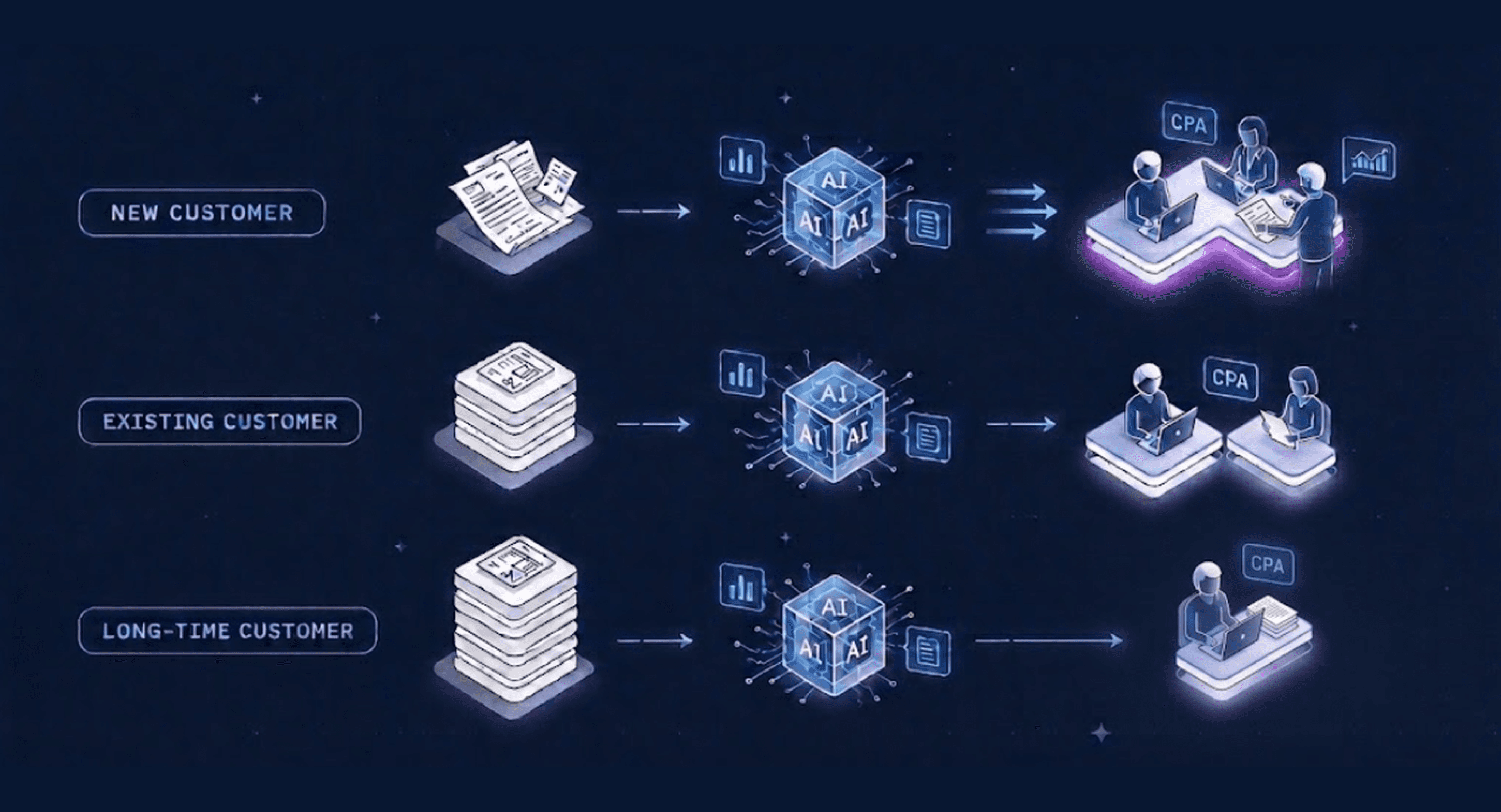
Arclow is an AI native accounting service. AI handles the repetitive work, and CPAs confirm it. As our AI learns your business, our efficiency and margin improve, and we pass those savings back to you through what we call "Learning Dividends": pricing that goes down over time instead of up. Complexity-based pricing is the other half of that promise. The price reflects the actual work your books require, and it's on the page before we ever get on a call.
Want to know what your books would cost? The calculator takes about two minutes, and we'll follow up to confirm what we understood and what we can do for you.
Disclaimer: Arclow is not a law firm and does not provide legal advice or legal services. This article is general information, not legal, tax, or accounting advice for your specific situation, and reading it does not create a client relationship with Arclow.