How Much Do We Actually Trust the AI? It Depends on How Long We've Worked Together
Insights
What changes as the AI learns your business, what doesn't, and why a CPA confirms the numbers either way
Published
Author

Isaac Lee, CPA
Founding Member, Accounting & Tax
Why "trust the AI" is the wrong question
People ask us some version of the same question a lot: how much do you actually trust the AI? It's a reasonable thing to ask, but it's the wrong shape for the answer. Trust isn't a switch we flip once and leave alone. It's a number that moves, client by client, the longer we work with your books.
A client we just started doing bookkeeping for and a client we've run AI on for a few months get reviewed differently, on purpose. Not because the AI itself got smarter overnight, but because it learned something specific: your business.
What the AI is actually learning
Every business has its own normal. One client runs a single vendor for inventory and pays them the same day every month. Another runs a dozen vendors on irregular terms. One client's revenue is lumpy because they sell to a handful of large accounts; another's is smooth because they run thousands of small transactions a day.
None of that is written down anywhere the AI can read on day one. It has to be learned from the pattern of the books themselves, close after close. A transaction that would be a clear anomaly for one client is completely normal for another, and the AI only knows the difference once it's seen enough closes to know what normal looks like for that specific business.
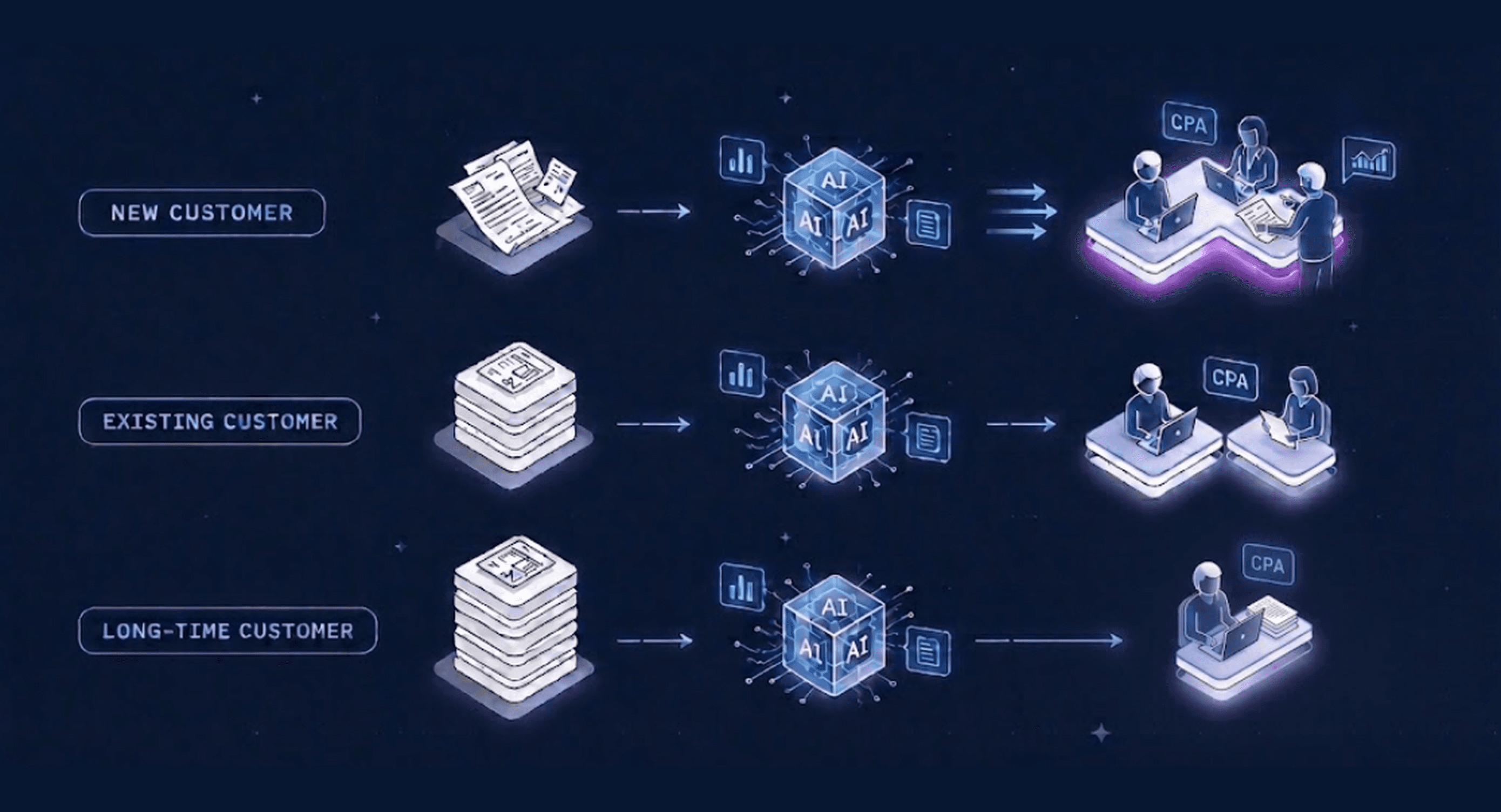
A new client, a few months in
Take two clients we work with right now. One is brand new, we just took over their bookkeeping this month. The other we've been running AI on for a few months.
For the new client, almost everything gets a close look. The AI proposes categories based on general patterns since it has nothing specific to this business yet, and a general pattern is exactly the kind of thing that's right most of the time and wrong on the case that actually matters. A controller is checking broadly here, not because the AI is bad at its job, but because it hasn't had the chance to learn this client's version of normal.
For the client we've worked with for a few months, the difference is obvious in how the review actually goes. The AI's categorization proposals consistently match what a controller would have picked anyway. The vendors are familiar, the payroll pattern is familiar, the revenue pattern is familiar. Review isn't wide anymore, it's targeted. A controller spends time on the transactions that are actually unusual for this specific client, not on rechecking the ones that were never going to be wrong.
This is also where Learning Dividends come from. As the AI's accuracy on a specific client's books improves, the hours we'd otherwise spend on wide review go down, and we pass that back as pricing that decreases over time instead of increasing.
Where the floor actually sits, no matter how long we've worked together
Some things do get automated as we learn a client, but there's a real floor beneath that narrowing, and it doesn't move no matter how many months we've been on your books.
Revenue recognition is often automatable, and often isn't, and that split doesn't move much no matter how long we've worked with a client. A subscription paid upfront and recognized straight-line over twelve months is a rule, once that rule is set up, the AI applies it every month without a second look. A performance obligation that's satisfied on a fixed schedule, like revenue recognized 30 days after a sale, can be rule-based the same way. What doesn't move to a rule is anything where recognizing revenue depends on judging whether the obligation was actually met this specific time, a shipment that may or may not have gone out, a service that may or may not be complete. And for a lot of smaller businesses, building and maintaining a custom rule for a less common revenue pattern isn't worth the cost even when it's technically possible, so it stays a manual check simply because automating it wouldn't pay for itself.
Anything new or ambiguous stays manual, no matter how long we've worked together. A new revenue stream or vendor, a transaction type the client's never had before, a check with no memo, a Zelle payment showing a person's name instead of a business name: none of that gets fixed by history, because there's either no pattern yet to learn from or not enough information in the transaction itself to categorize it.
And every number that reaches a client, regardless of how narrow the review got, is still confirmed by a CPA before it goes out. Time on the books changes how wide the net is cast. It never changes whether someone signs off.
The result
Trust isn't something we grant to the AI in general. It's something that accumulates client by client, close by close, and it only ever applies to the parts of the work that are genuinely repeatable. The parts that require judgment stay exactly as manual on a client's tenth close as they were on their first.
Working with arclow
Arclow is an AI native accounting service. AI handles the repetitive work, and CPAs confirm it. As our AI learns your business, our efficiency and margin improve, and we pass those savings back to you through what we call "Learning Dividends": pricing that goes down over time instead of up.
Want an accounting team that gets faster and cheaper the longer you work with it, without giving up the judgment calls that actually matter? Reach out.
Disclaimer: This article is general information only, not legal, tax, or accounting advice, and reading it does not create an accountant client relationship.